
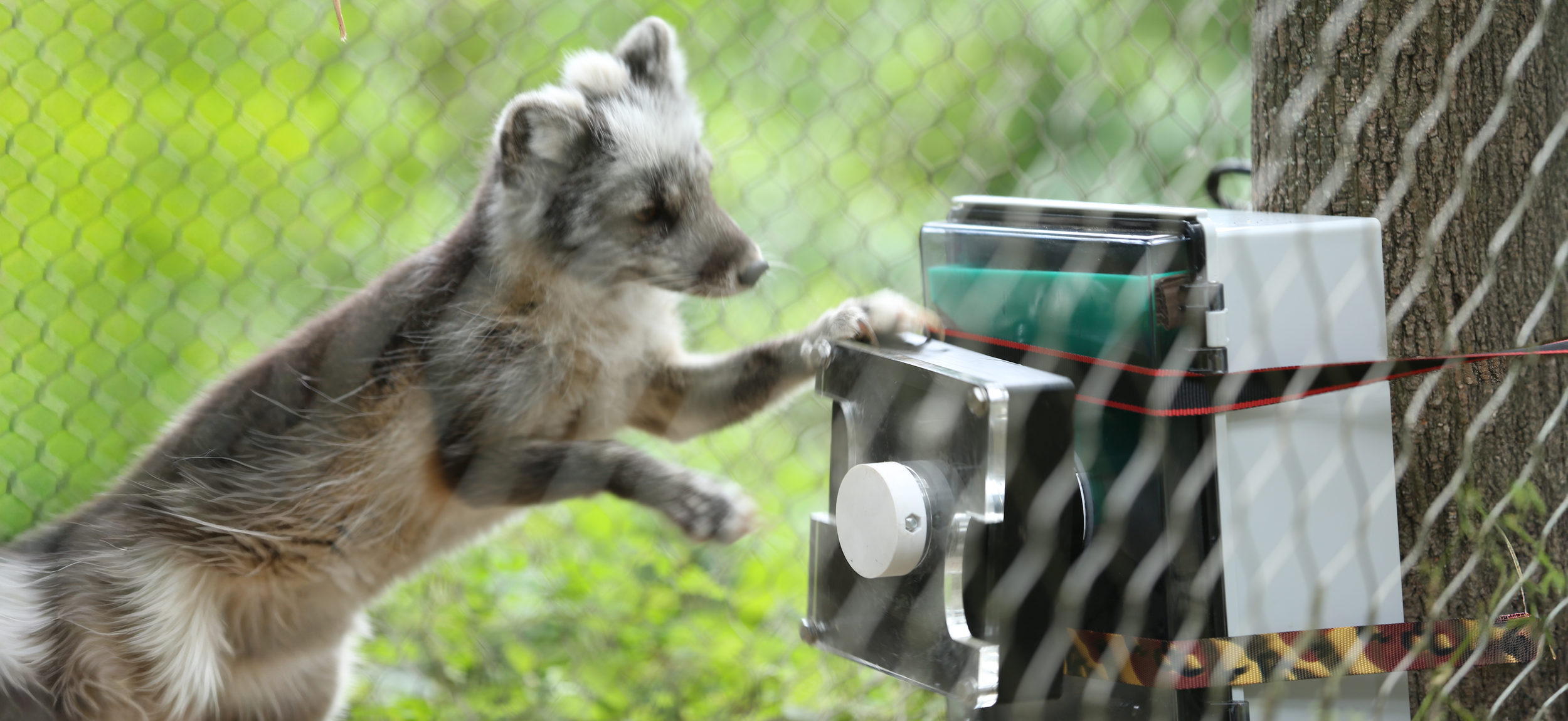
Outfoxed
Design and Evaluation of a Modular Interactive Puzzle for Cognitive Enrichment of Zoo Animals
Vatsal Mehta, Somil Urmil Shah, Lubaina Malvi, Willem Shak, Felix Sims, Sarah Woodruff, Rébecca Kleinberger,
🗞 Media email contact@interactanimallab.com for access
📄 Paper: Access the full publication
Collabroative Institutes:


About
Cognitively stimulating experiences are fundamental to supporting the welfare of zoo-housed animals. Puzzle-feeders are often initially engaging, but require frequent human intervention and often lack adaptability to support animals’ sustained cognitive engagement. We developed a modular adaptive interactive puzzle-feeder designed to support user agency, independence, and multisensory feedback. The system was deployed over four weeks with an Arctic fox across progressive difficulty levels and piloted with two coatis. Combining HCI and animal science methodologies, we assessed (1) multisensory engagement, (2) behavioral transformation and habitat utilization, (3) adaptation to puzzle complexity, (4) cross-species modularity, and (5) impact on human stakeholders. Results show strong sustained engagement (46.5% time-budget), increased behavioral diversity, habitat exploration, strategic problem-solving, and positive keeper and visitor reactions. This work highlights how technology can support animal welfare and visitor experience, and how mixed HCI and ethological methods enable holistic evaluation of enrichment and animal usership.
Four weeks. One Arctic fox. A puzzle that kept getting harder. Here is what he showed us.
A structured, progressive deployment
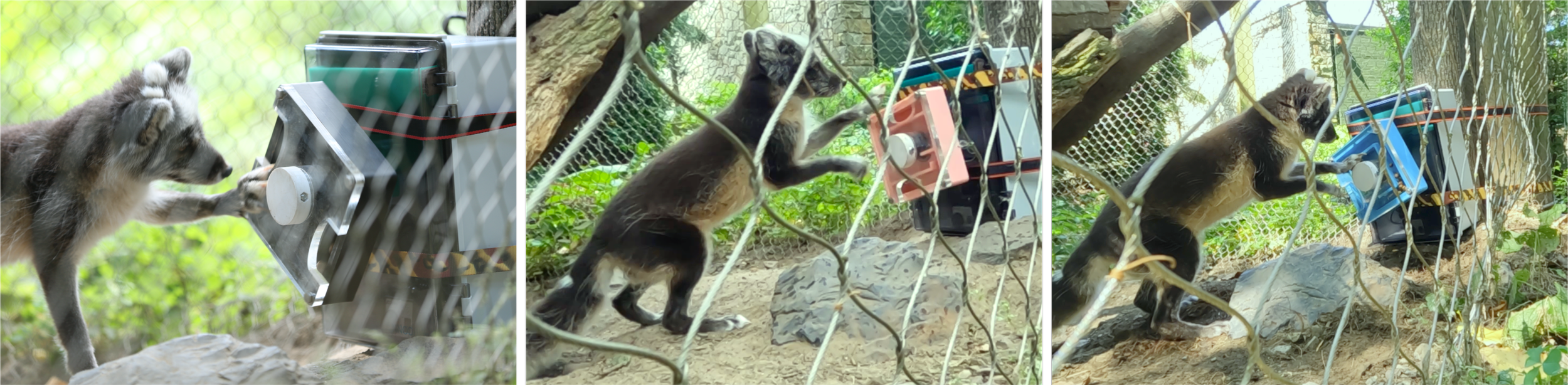

The system was deployed over four weeks with a single Arctic fox, organized as five baseline and five deployment sessions of one hour each. The puzzle was installed in an underused area of the enclosure to draw the fox away from his preferred resting site, and was advanced through five progressive difficulty levels as he mastered each configuration. Food releases were delivered and capped per session, keeping the rewards negligible against his regular diet so the study measured genuine interaction rather than feeding.
Sustained engagement across sessions
The fox solved the rotation mechanism within minutes of the first session and approached the puzzle within seconds of each setup. Engagement held at 46.5% of his time budget across three weeks of deployment.
An expanded behavioral repertoire
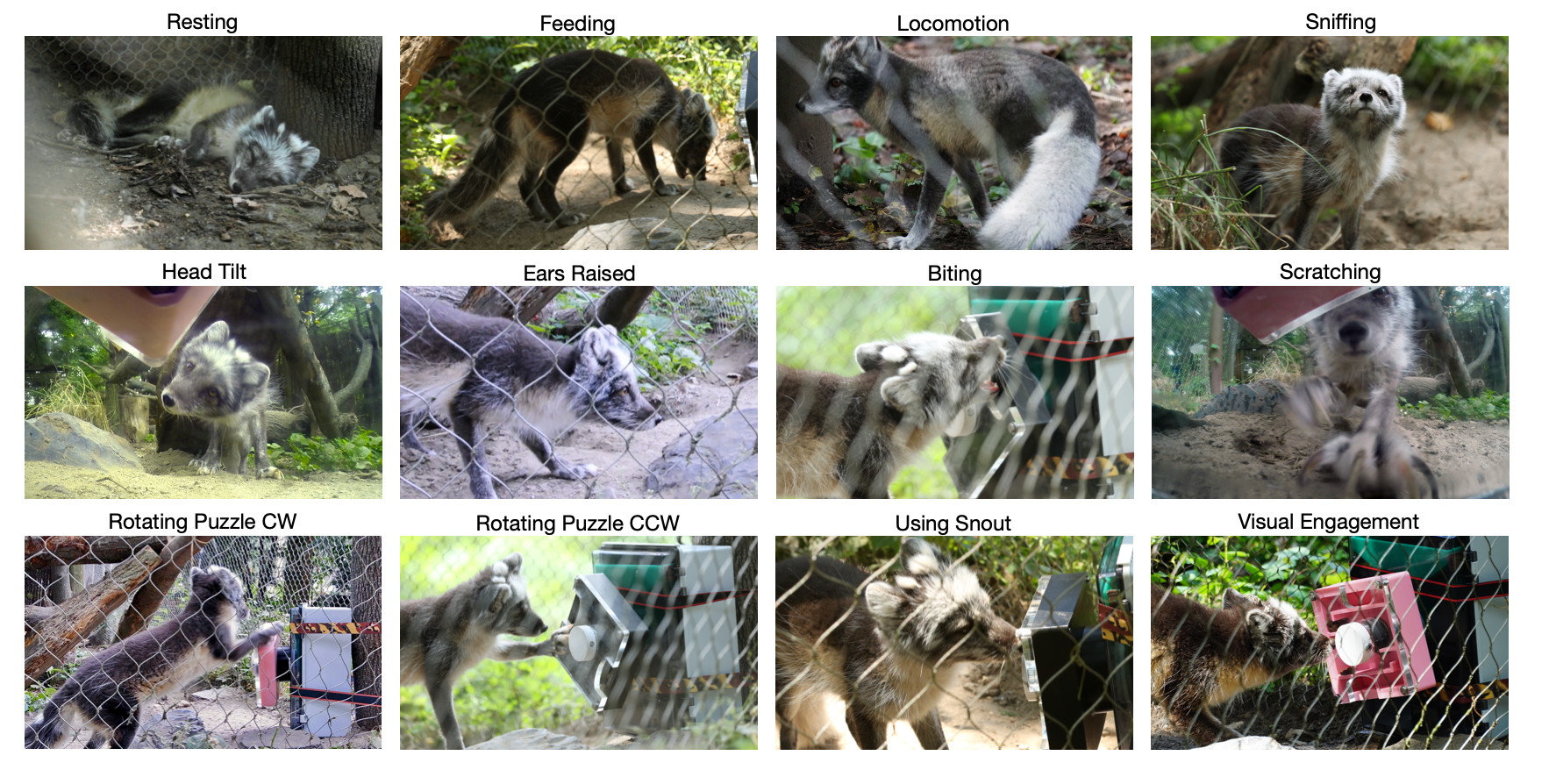
At baseline, the fox's activity was dominated by resting, with only brief bouts of locomotion and sniffing. Across deployment we coded a far wider range of behaviors spanning foraging, manipulation, and investigation: feeding, locomotion, sniffing, head tilting, ears raised, biting, scratching, clockwise and counterclockwise rotation of the puzzle, snout use, and sustained visual engagement. This shift away from inactivity and toward active, exploratory categories raised the Shannon entropy of his behavior from 0.49 at baseline to a deployment mean of 1.21, a 148% increase in behavioral diversity that held across all five sessions.
Tested in simulation first

Each opening and difficulty level was modeled and tested in 3D before the system was built and deployed. The final design is modular, so swapping a single face raises the difficulty as the animal adapts.
Recorded from six angles
Every session was captured by six synchronized cameras, from a lens inside the feeder to a wide view of the visitor path. The setup documented each interaction for behavioral coding.
Expanded habitat utilization

Placed in an underused corner, the puzzle drew the fox away from his single resting site and across the habitat. His measured use of space more than tripled, with movement patterns closer to wild foraging.
The findings inform guidelines for adaptive enrichment systems built around how a species senses, moves, and solves problems.
Publication
Outfoxed: Design and Evaluation of a Modular Interactive Puzzle for Cognitive Enrichment of Zoo Animals Vatsal Mehta, Somil Urmil Shah, Lubaina Malvi, Willem Shak, Felix Sims, Sarah Woodruff, Rébecca Kleinberger. Proceedings of the 2026 CHI Conference on Human Factors in Computing Systems. 2026, PDF, DOI