BearBubbles
Interactive Olfactory Enrichment to Encourage Foraging in Zoo Animals
Arushi Aggarwal, Sarah Woodruff, Jas Brooks, Rebecca Kleinberger
🗞 Media email contact@interactanimallab.com for access
📄 Paper: Access the full publication
Collabroative Institutes:


About
Enrichment is critical for zoo animal welfare. Commonly used food-based approaches have limitations in terms of sensory diversity, agency, redundancy, time budget, and nutrition. Building on research into agency-based technologies, choice-driven enrichment, and species relevant sensory engagement, we developed an interactive proximity activated scented bubble system for two American black bears (Ursus americanus). This project integrates behavioral intervention with HCI methodology to create animal-controlled olfactory enrichment. Over a three-week deployment, we assessed (1) enrichment potential through system use, behavioral diversity, and habitat use; (2) usership via engagement patterns with the bubbles; (3) sense-making and agency through anticipation behaviors; and (4) human stakeholder perspectives via visitor and staff surveys. Results show the intervention increased target foraging and locomotive behaviors compared to post-feeding baselines, generated rich multi-modal interactions, and received positive stakeholder feedback, illustrating how technology can promote animal agency while supporting zoo welfare and educational missions.
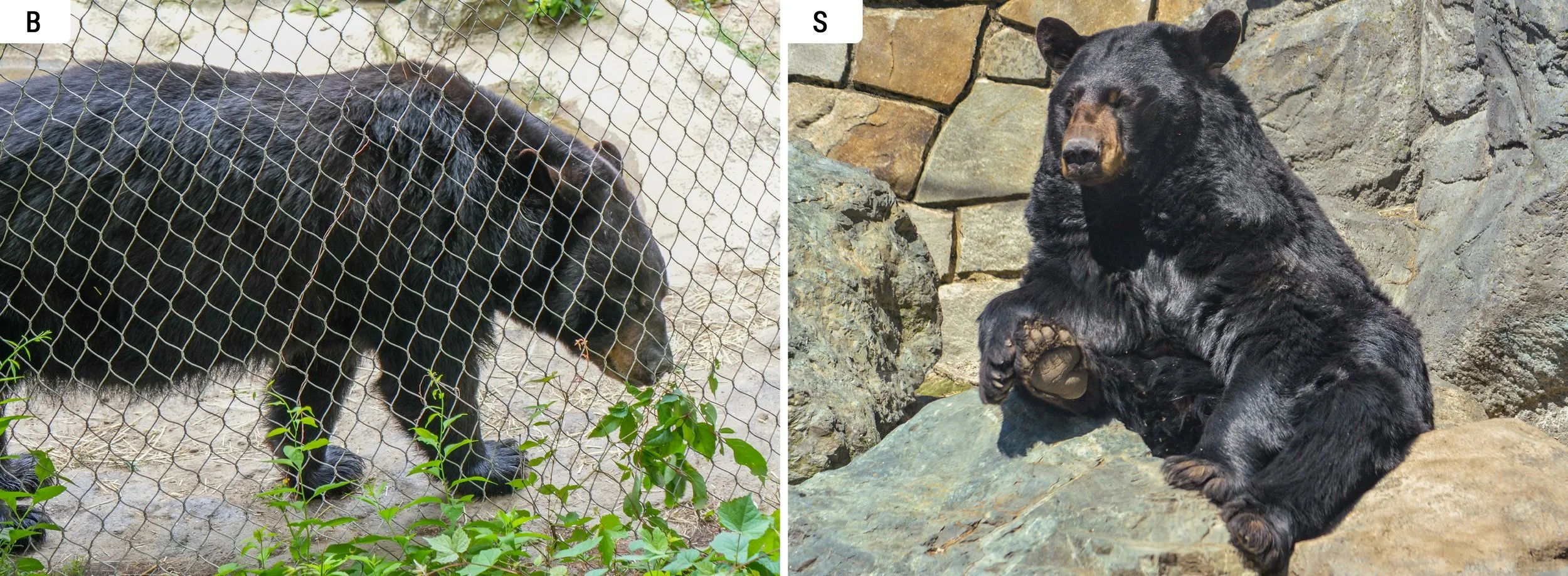
Meet Bubba and Smoky. Rescued as cubs, they've lived at Stone Zoo for nearly two decades.
Bubba and Smoky were rescued as two-pound cubs and brought to Stone Zoo after being deemed too habituated to humans for release into the wild. As geriatric bears, they face a challenge familiar in managed care: staying active and mentally engaged as age slows them down. Food-based enrichment raises weight-management concerns, and static scent applications wear off quickly. Their specific needs, and the zoo team's deep knowledge of them, shaped every design decision in BearBubbles.
A system the bears control entirely
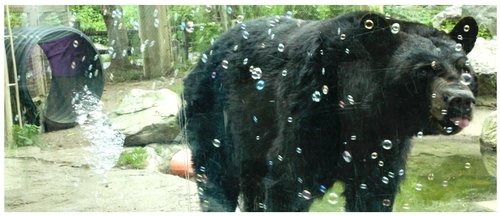
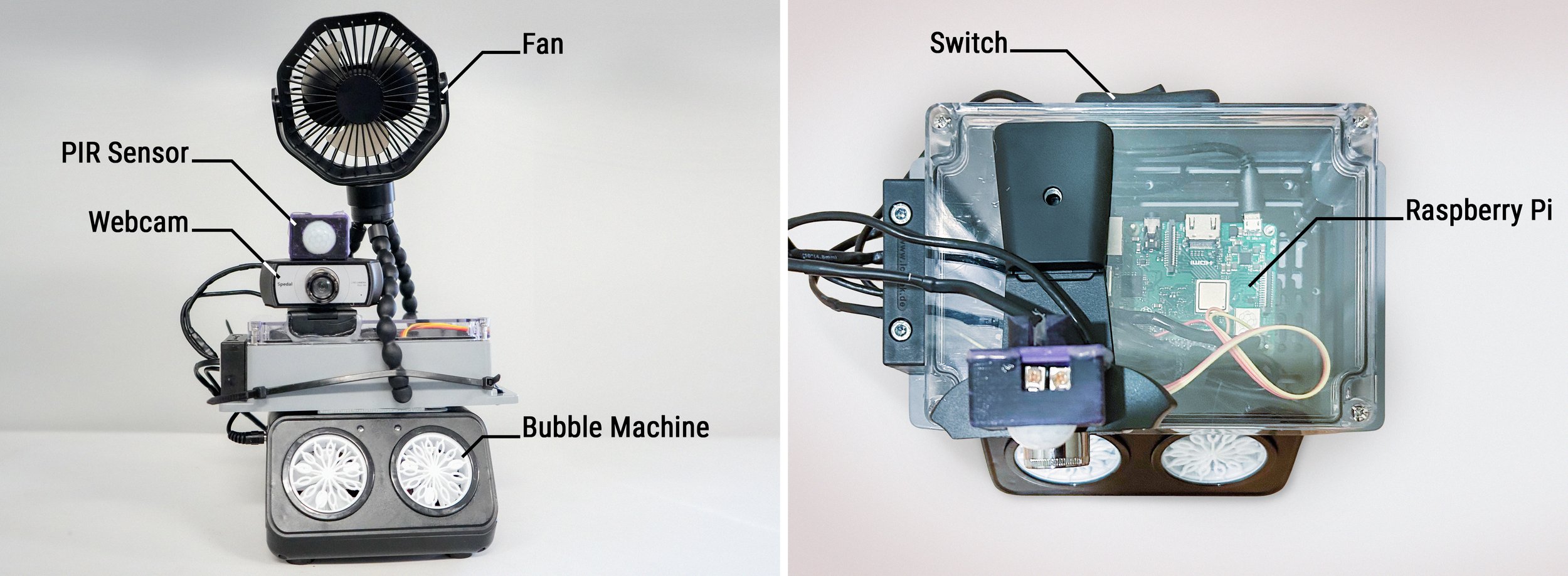
Each BearBubbles unit houses a passive infrared sensor, a bubble machine, a small fan, and a microcontroller in a weatherproof box, built for roughly $125 in components. When a bear enters the sensor zone, the system releases a 15-second burst of scented bubbles directed into the habitat. A built-in cooldown pauses activation after five minutes of continuous triggering to prevent overstimulation. Because the sensor responds to thermal motion, every release is bear-initiated. The enrichment happens on the animals' terms, not the keeper's schedule.
Foraging extended well beyond active feeding
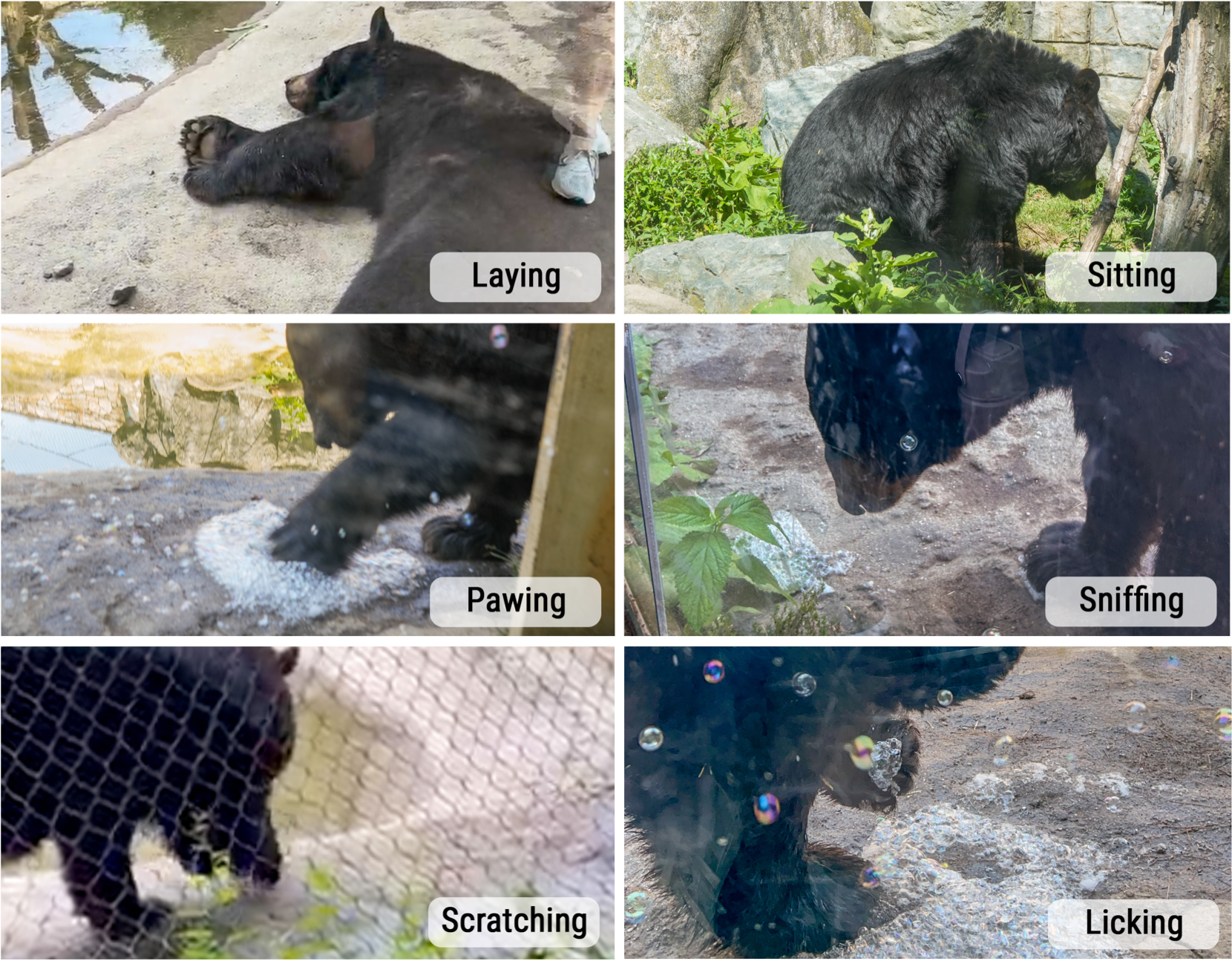
Foraging behaviors (sniffing, licking, pawing, nosing) occupied just 1% of session time during post-feeding baselines, once food was no longer available. During BearBubbles deployments, that rose to 5.3%, a statistically significant increase with a large effect size. Unlike food enrichment, which stops driving investigative behavior once the meal is found, BearBubbles kept foraging duration elevated well past active feeding, generating sustained investigative activity with no dietary cost.
The bears displayed sense-making of their own control
Across all seven deployment sessions, both bears showed consistent anticipatory behaviors as they approached the devices: slowing their pace, pausing in the trigger zone, and orienting ears and gaze toward the unit before any release occurred. This pattern appeared reliably session after session, demonstrating that the bears recognized the spatial contingency between their own presence and the bubble release. The system's design ensured that this control was always real: entering the trigger zone was the only way to activate it, keeping the outcome fully in the bears' hands.
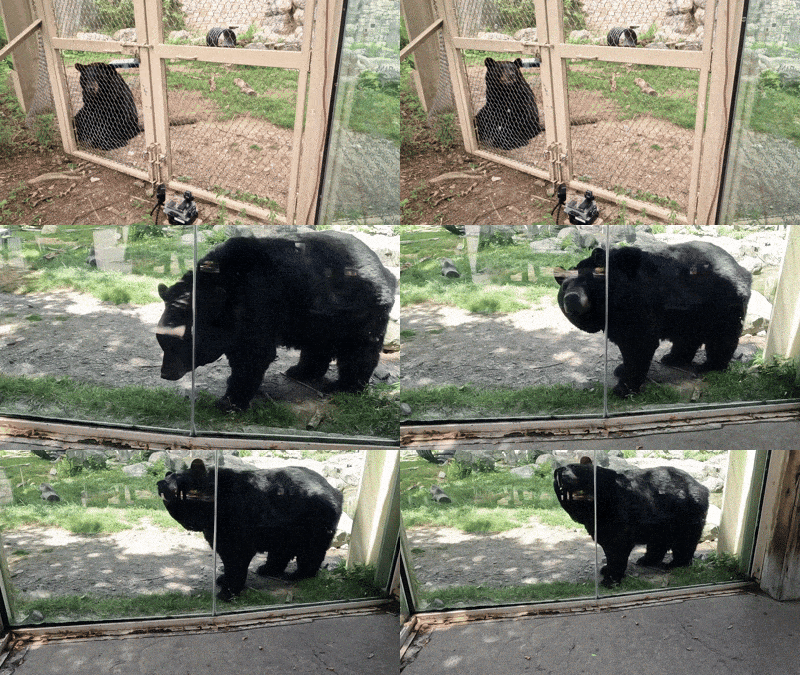
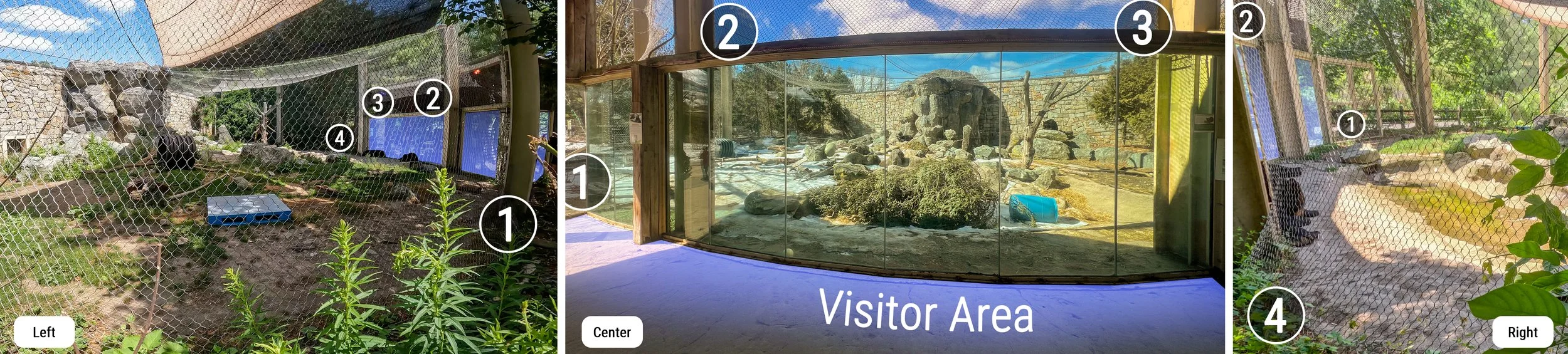
Lemon, maple bacon, and peanut butter were chosen in consultation with Stone Zoo staff based on the bears' existing enrichment history: food-reminiscent scents that sustained exploratory behavior without adding to the bears' diet, since all sessions followed the morning feeding. Scents rotated across four distinct device locations throughout the deployment, and engagement held steady across all seven sessions, confirming the system's effects weren't a one-time novelty response but a sustained pattern across the full three-week study.
Three scents. Four locations. Seven sessions across three weeks.
Co-designed with over 120 years of zoo expertise
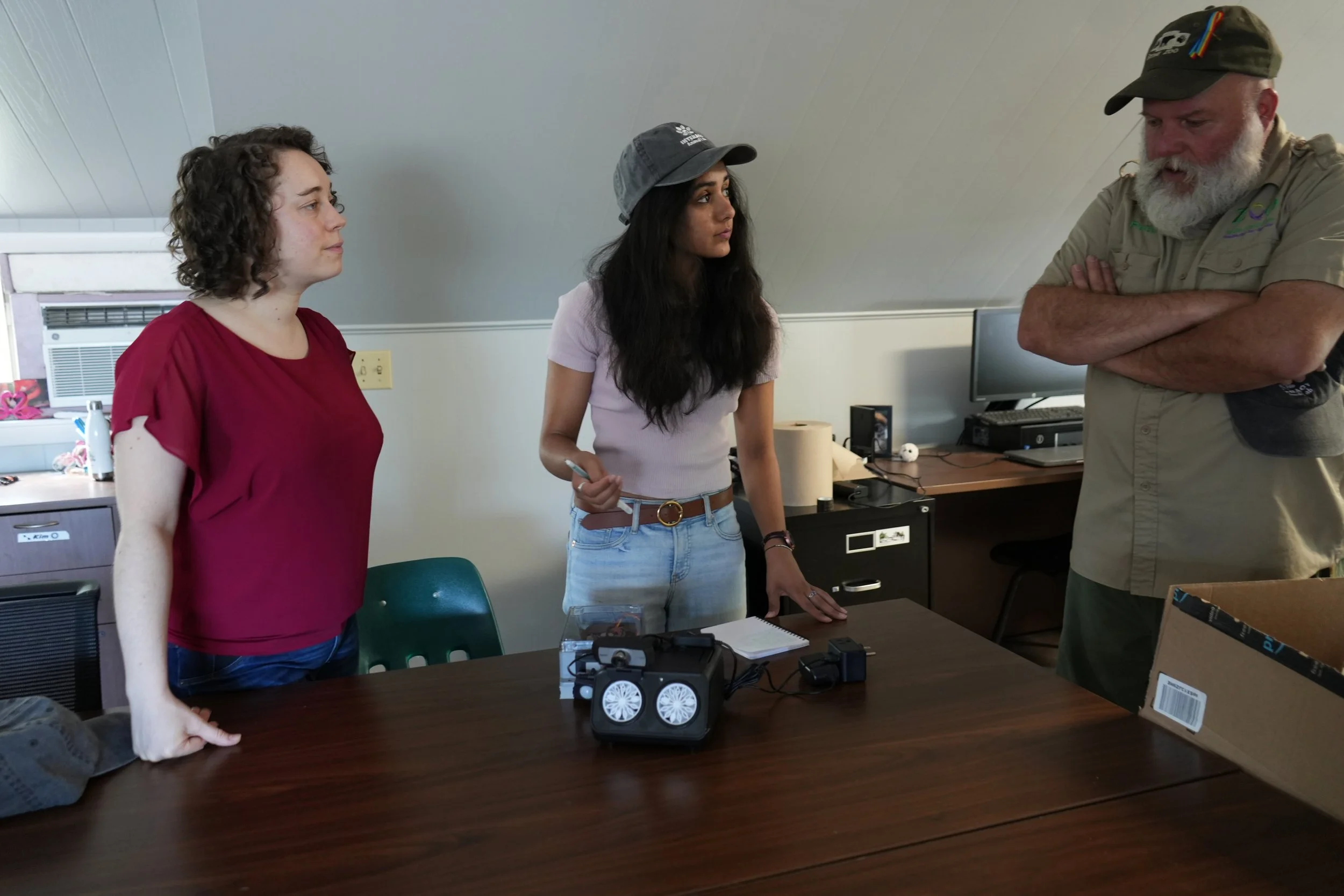
Over five months, the system went through three prototype iterations guided by Stone Zoo's Zookeepers, Curators, and Animal Wellbeing Advisor. Their combined expertise shaped every consequential decision: scent selection, sensor type, timing logic, and the move from button or visitor-triggered activation to passive proximity sensing. After the study concluded, the team delivered a simplified final version to the zoo for long-term keeper use, the clearest marker of a design that worked in the real world.
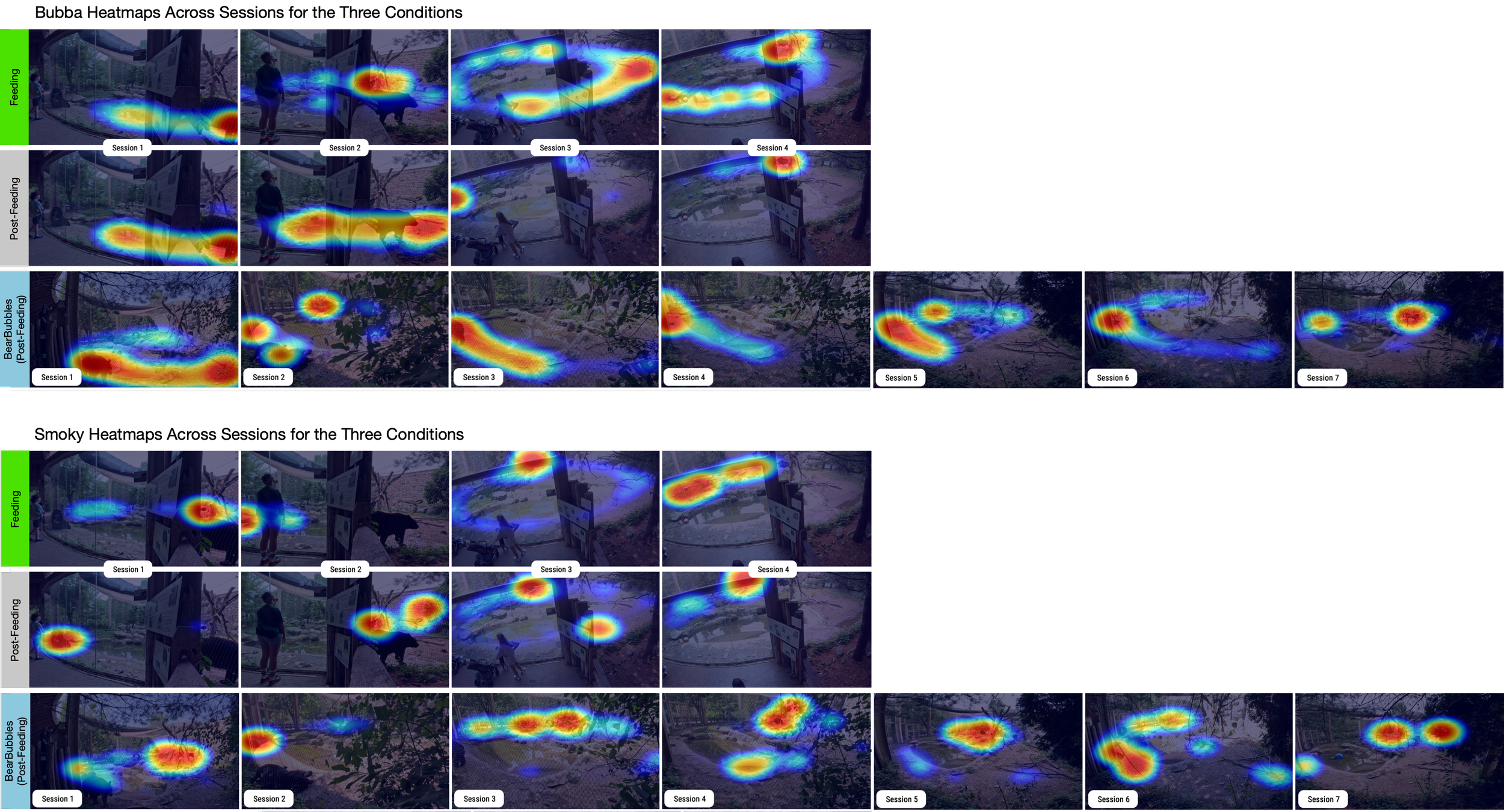
Habitat engagement expanded to nearly half the available space
During post-feeding baselines, Bubba stayed near the visitor glass and Smoky barely moved from one or two resting spots, together using less than 20% of the habitat surface. During BearBubbles sessions, both bears moved broadly across the space, with active behavior concentrated near each of the four enrichment locations. Deployment extended habitat engagement to nearly half the available surface area, a recognized marker of enrichment success.