Colobus Curio Cabinet: A Modular, Mirror-Based, Co-Designed Enrichment Proposal for Colobus guereza
Omi Johnson, Victoria Klimkowski, Shannon Haley, Cailigh MacDonald, Sarah Woodruff, Rebecca Kleinberger.
ACI '25: Proceedings of the ACM 12th International Conference on Animal-Computer Interaction, PDF, DOI
ABSTRACT
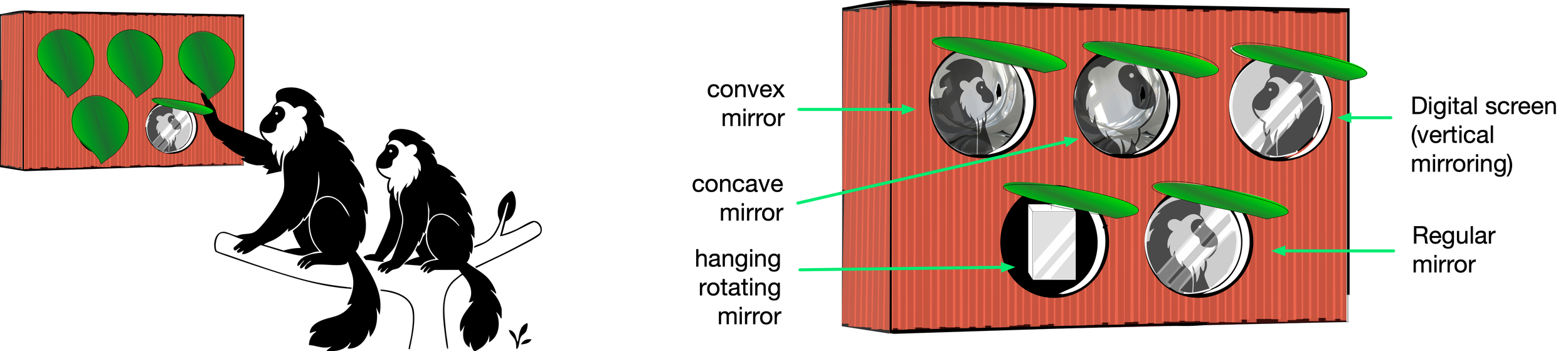
This work explores complex non-food based enrichment for zoo-housed primates through the design, iterative co-design process, and proposed evaluation of a modular, mirror-based enrichment system developed for zoo-housed Colobus guereza monkeys. The interactive enrichment proposal, which leverages the Colobus troop’s interest in reflective surfaces, proposes modular inserts containing various mirrors and screen-based interfaces within a wall-mounted "Curio Cabinet" with natural-looking module covers. The design of the Curio Cabinet aims to simulate natural exploration and problem-solving behaviors while promoting physical, cognitive, and sensory engagement. Drawing from principles in Animal-Computer Interaction (ACI) and animal enrichment literature, the proposal was iteratively co-designed with zoo professionals. This design contributes to the broader application of animal-centered design in zoo settings toward a new paradigm that supports animal’s choice and control in their environmental interactions. The design also challenges conventional "mirror-test" approaches by exploring an animal’s agency-driven, personal sense-making journey with reflective surfaces. The proposed deployment protocol opens opportunities to investigate new research questions around mirror enrichment and long-term engagement. Finally, the work provides a detailed account of a collaborative design pipeline and recommendations for future iterative co-design processes in complex zoo enrichment.